Crafting branded content with editorial integrity

As a contributing editor for Creative Review, I’ve created content strategies for global brands including Frontify, Figma, Meta and TikTok.

Together, we transformed CR’s approach to branded editorial, developing multi-part series that engage an audience of senior design professionals while achieving each partner brand’s strategic objectives.
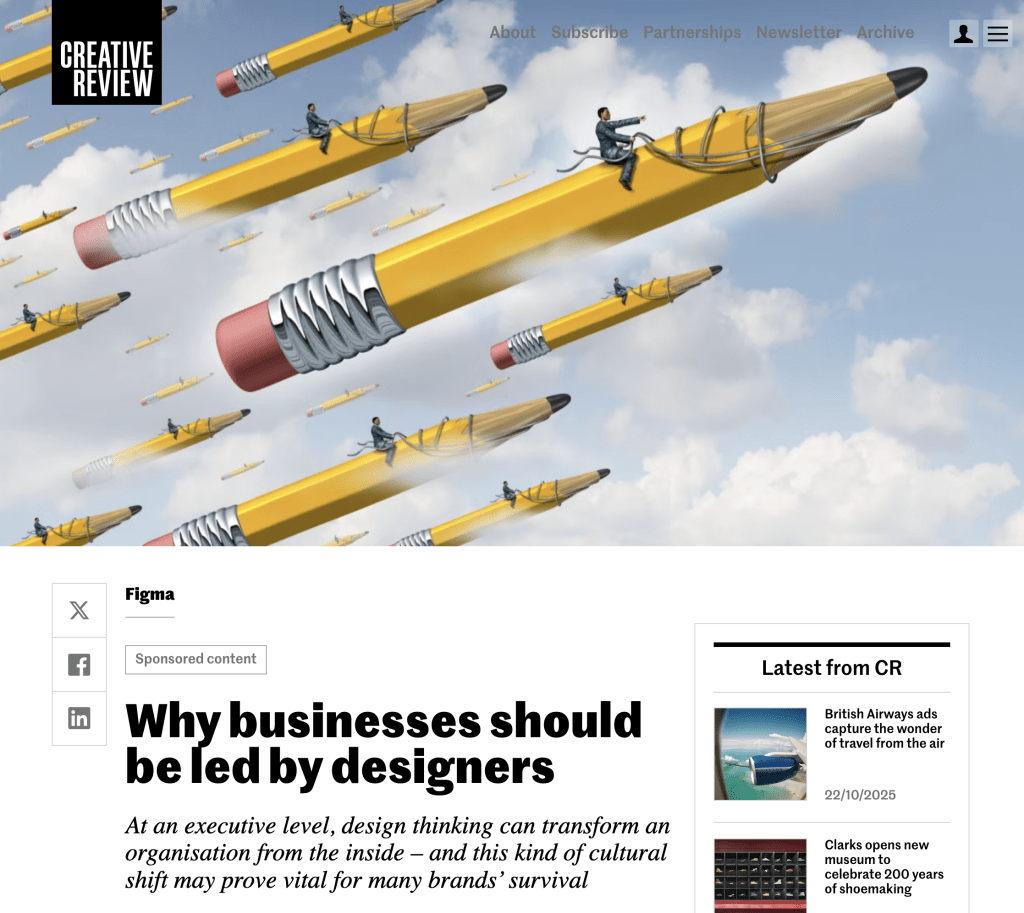
Image credit: Creative Review / Shutterstock

The work balances three objectives: maintaining CR’s high editorial standards, engaging the design community with compelling and relevant insights, and achieving measurable results for brand partners.

By treating sponsored content as seriously as editorial features – with rigorous research, compelling angles, and authentic perspectives – the content earns reader attention rather than interrupting it.

Figma

Why businesses should be led by designers
At an executive level, design thinking can transform an organisation from the inside – and this kind of cultural shift may prove vital for many brands’ survival

Why non-designers must understand design better
Appreciation of the design process should permeate an entire organisation, not just its in-house creative team

Frontify

The trick to pushing creative limits without losing control
How to balance rule-breaking creativity with the need for measurable performance and brand governance

Why a brand-building platform helps creativity thrive
Some extra groundwork to create a ‘single source of truth’ when building a brand empowers everyone down the line

Team ITG

How virtual production is changing the way ads are made
Virtual production unlocks limitless creative possibilities, while making the process more efficient and sustainable

Pushing the limits of creativity with virtual production
VP’s rapid evolution helps brands break new ground without breaking the budget

Video credit: Creative Review / Team ITG

TikTok

How brands can be authentic on TikTok
Insider advice from Burberry, Rimmel and Duolingo to thrive in TikTok’s world of democratised creativity

Why brands should be part of the community on TikTok
Move aside, always-on marketing: brands need to be ‘always in’ to win the trust and attention of TikTok’s diverse communities

Meta

How the metaverse could transform brand engagement
Early adopters in fashion and entertainment are blazing a trail, but how could brands in other sectors embrace the potential of the metaverse?

Unlock more immersive brand experiences in the metaverse
Brands must dream big to push experience design limits in the metaverse

“Nick has all the attributes of a great content strategist – a strong sense of editorial values, audience interests and commercial awareness. He has become integral to our team.”

Michael Barnett – Commercial content editor, Creative Review and Marketing Week

Why your design agency needs a ghostwriter

Full of strong opinions, but short on time to articulate them?

At its best, design is a thoughtful, considered profession as much driven by bold ideas as aesthetics. And as a cursory dip into ‘design Twitter’ will attest, there’s no shortage of opinions in this business.

But be honest. How often do those opinions become part of a joined-up, effective content strategy for your agency to win new clients?

Read more: Why your design agency needs a content strategy

Whether selling a bold solution to a wary client or crafting a brand strategy to win over sceptical consumers, designers are in the persuasion game. But current client demands come first. Getting thoughts down on paper in a coherent way takes time to do properly. And you need to do it properly.

It’s no use forcing out opinions for the sake of it. If it’s not your authentic standpoint, what’s the point? You need to find an engaging, relevant angle that sheds light on how you work, how you think, what makes you unique.

If all this sounds familiar, but you struggle to prioritise getting it done, I can help you articulate a client-winning thought-leadership strategy – including persuasive content that’s ghostwritten in your agency’s voice.

My editorial background helps me get to the heart of your story quickly, and craft a convincing narrative pitched at your target reader. And whether it’s a one-off piece on a particular theme, or a big-picture content strategy that runs for months, it begins with an in-depth, face-to-face chat.

This is a great opportunity not only to gauge what your opinions and attitudes are, but how you express them – from general style and mood to particular turns of phrase. Tone of voice is a crucial part of any branding toolkit for your clients, so why neglect your own?

Once we agree on an angle, tone and format, I’ll collaborate closely with you to get the content spot-on.

So what does this look like in practice?

I worked with the Red Setter team on a provocative thought-leadership article about ‘brand euthanasia’ for their client B&B Studio, to fuel its reputation for empowering disruptive, forward-thinking challenger brands.

Marmite: B&B’s example of a heritage brand that has stayed relevant. Image credit: City AM

In the firing line: lazy, slow-moving brands that have lost their relevance, but are kept on life-support by empty ‘brand refreshes’ and nostalgia.

Fuelled by expert insights and contentious opinions from B&B’s senior team – including bylined strategy director Lisa Desforges – the short, punchy ghostwritten article was placed by Red Setter in City AM’s opinion section.

Case study: B&B Studio on brand euthanasia

I also helped Studio Output produce a long-form piece to reflect its new strategic positioning: the agency helps brands to adapt and thrive in a connected world.

Following an in-depth briefing session with the senior team, I worked closely with ECD Rob Coke to express the agency’s sector-leading creative approach in written form – using three case studies to show it in action.

Case study: Studio Output’s strategic repositioning

Looking forward to 2020, I’m collaborating with three very different UK agencies on their longer-term strategic content plans, which will start rolling out in the coming months. More on that in due course.

Need help turning your in-house expertise into client-winning thought leadership?

Arguing a strong case for ‘brand euthanasia’

Image credit: City AM
  • Client: Red Setter / B&B Studio
  • Disciplines: Thought leadership, ghostwriting
  • Duration: 1 day

I collaborated with Red Setter and their client B&B Studio on a provocative thought-leadership article about ‘brand euthanasia’. In the firing line: lazy, slow-moving brands that have lost their relevance, but are kept on life-support by empty ‘brand refreshes’ and nostalgia.

The article argued that old-fashioned brands that no longer cater to a real need or desire should make room for the next generation of challengers – and moreover, that no one will miss them when they’re gone.

Alongside high-street failures Woolworths and Blockbuster – too sluggish to adapt in the age of Amazon and Netflix – this included the counter-example of a heritage brand that has managed to stay relevant: Marmite.

Fuelled by expert insights and contentious opinions from B&B’s senior team – including bylined strategy director Lisa Desforges – the ghostwritten article was placed by Red Setter in the City AM opinion section.

Read the story on City AM

Clarifying an agency’s new strategic positioning

Image credit: Studio Output

I helped Studio Output articulate how it helps brands to “adapt and thrive in a connected world”.

Following an in-depth briefing session with the senior team, I worked closely with executive creative director Rob Coke to translate the agency’s new strategic positioning into a thought leadership article.

Read full article on Output’s website

Here’s an excerpt:

Why your brand must adapt to thrive

The connected world has shifted behaviours and transformed expectations. As consumers, we’re faced with more choice, more powerful technology and more immersive experiences than ever before. In this world, the experience of your digital products is what defines your brand.

Switched-on brands – those that understand the importance of embracing a digital mindset to succeed in today’s world – are disrupting their sectors and dancing to the rhythm of fast-changing demands. They’re not just responding to the future, they’re creating it – by continually pushing boundaries and challenging themselves to adapt to the unknown ahead of their competitors.

Airbnb put the idea of ‘belonging’ at the heart of every touchpoint. Netflix’s design and motion language showcases the content you love. Uber’s recent rebrand unifies its services with a modern, relevant visual system. And trillion-dollar giant Amazon completely re-framed expectations of service and delivery.

To disrupt their respective sectors, these four all understood one thing: the power of experience as a differentiator. They take people on a journey that conveys their brand values and personality at every touchpoint... [more]

Nick has a knack of capturing the magic of an interview and distilling it into attention-grabbing copy.
He makes the process enjoyable, and meets his deadlines. What more can you ask?

Rob Coke – executive creative director, Studio Output