Crafting branded content with editorial integrity

As a contributing editor for Creative Review, I’ve created content strategies for global brands including Frontify, Figma, Meta and TikTok.

Together, we transformed CR’s approach to branded editorial, developing multi-part series that engage an audience of senior design professionals while achieving each partner brand’s strategic objectives.

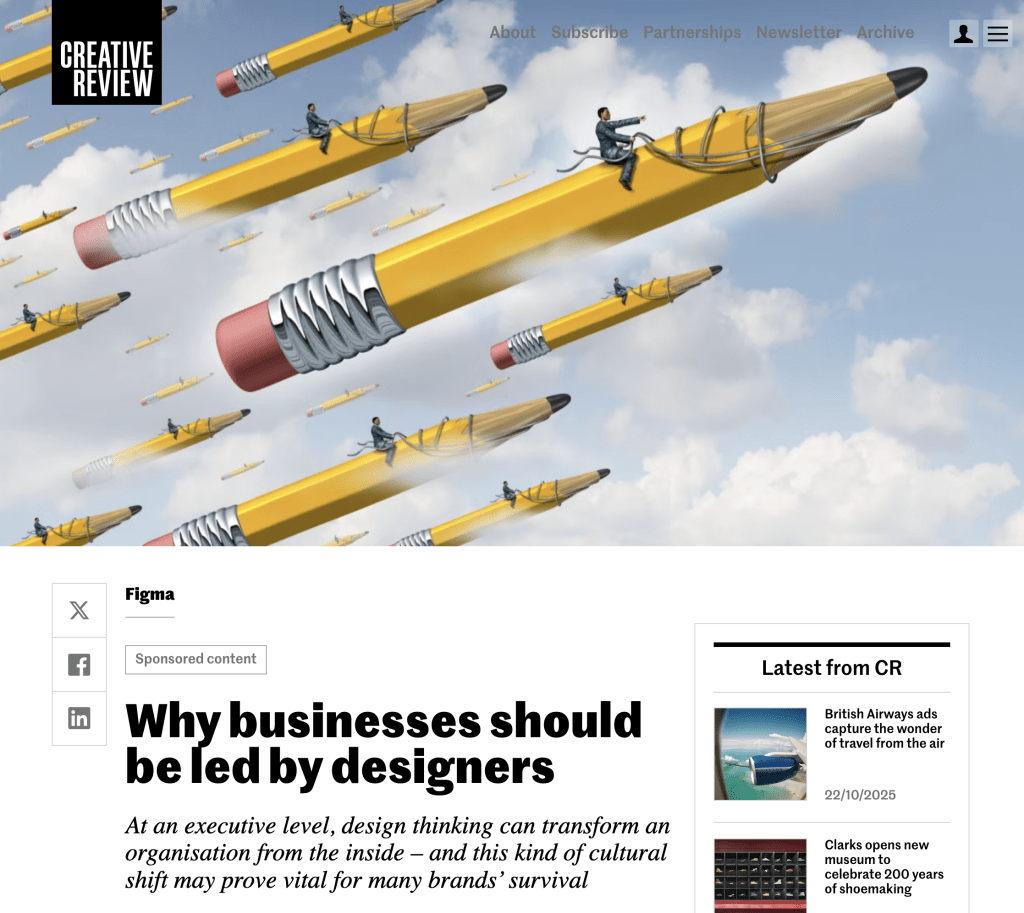
Image credit: Creative Review / Shutterstock

The work balances three objectives: maintaining CR’s high editorial standards, engaging the design community with compelling and relevant insights, and achieving measurable results for brand partners.

By treating sponsored content as seriously as editorial features โ€“ with rigorous research, compelling angles, and authentic perspectives โ€“ the content earns reader attention rather than interrupting it.

Figma

Why businesses should be led by designers
At an executive level, design thinking can transform an organisation from the inside โ€“ and this kind of cultural shift may prove vital for many brandsโ€™ survival

Why non-designers must understand design better
Appreciation of the design process should permeate an entire organisation, not just its in-house creative team

Frontify

The trick to pushing creative limits without losing control
How to balance rule-breaking creativity with the need for measurable performance and brand governance

Why a brand-building platform helps creativity thrive
Some extra groundwork to create a โ€˜single source of truthโ€™ when building a brand empowers everyone down the line

Team ITG

How virtual production is changing the way ads are made
Virtual production unlocks limitless creative possibilities, while making the process more efficient and sustainable

Pushing the limits of creativity with virtual production
VPโ€™s rapid evolution helps brands break new ground without breaking the budget

Video credit: Creative Review / Team ITG

TikTok

How brands can be authentic on TikTok
Insider advice from Burberry, Rimmel and Duolingo to thrive in TikTokโ€™s world of democratised creativity

Why brands should be part of the community on TikTok
Move aside, always-on marketing: brands need to be โ€˜always inโ€™ to win the trust and attention of TikTokโ€™s diverse communities

Meta

How the metaverse could transform brand engagement
Early adopters in fashion and entertainment are blazing a trail, but how could brands in other sectors embrace the potential of the metaverse?

Unlock more immersive brand experiences in the metaverse
Brands must dream big to push experience design limits in the metaverse

“Nick has all the attributes of a great content strategist โ€“ a strong sense of editorial values, audience interests and commercial awareness. He has become integral to our team.”

Michael Barnett โ€“ Commercial content editor, Creative Review and Marketing Week

Shifting perspective with a poetic wobbly mirror

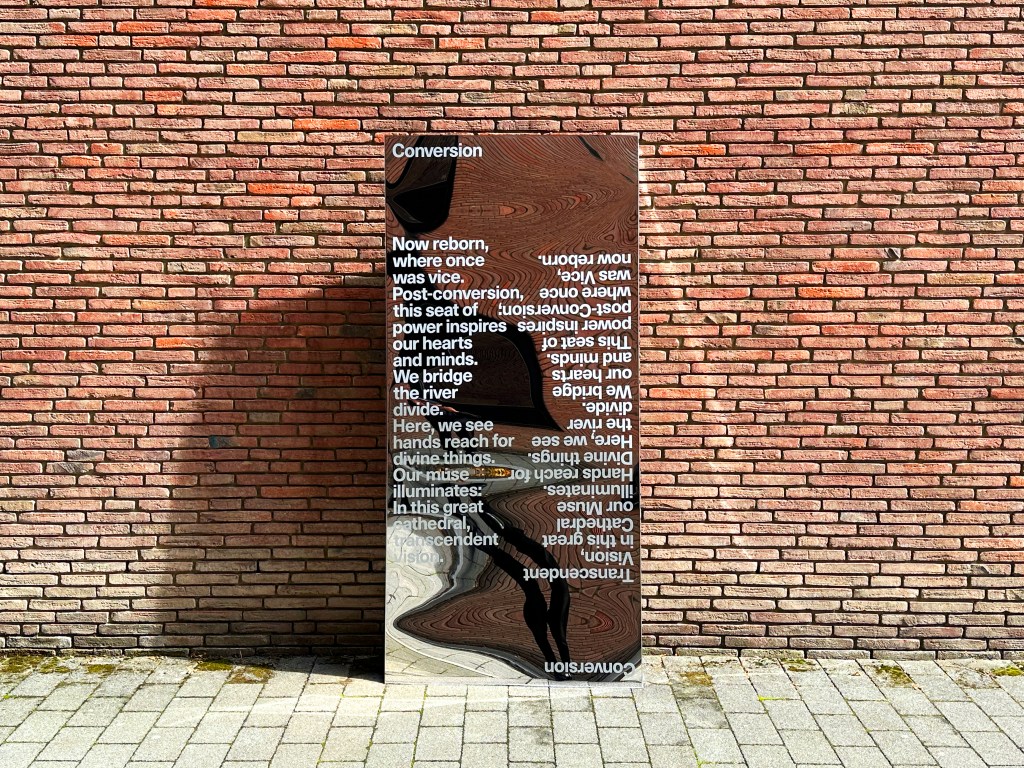
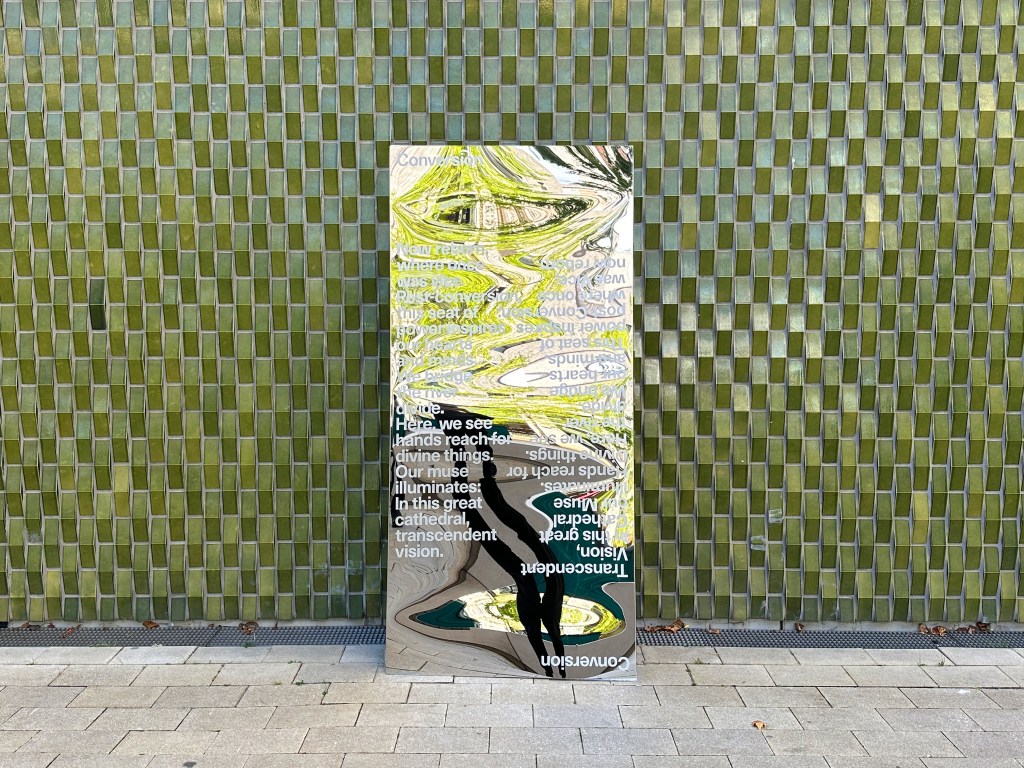
I collaborated with NB Studio and SEA to create ‘Conversion’, a two-metre-high fairground-style distorting mirror.

Part of the 26 Bridges initiative for Bloomsbury Festival 2025, the piece presents Millennium Bridge as a symbolic connection between two London icons: St Paul’s Cathedral and Tate Modern.

Photo credit: NB Studio

The title ‘Conversion’ operates on multiple levels: religious conversion (Catholicism to Protestantism); architectural conversion (Bankside Power Station becoming Tate Modern); and the broader transformation of the Bankside area from historic den of iniquity to cultural hub.

At the heart of the project is a palindromic poem that shifts perspective when flipped. Depending on which direction it’s read, dual-meaning terms โ€“ ‘vice’, ‘vision’, ‘muse’, and ‘divine’ โ€“ switch between sacred and secular significance.

Photo credit: NB Studio

The distorting mirror concept playfully references Millennium Bridge’s notorious nickname โ€“ ‘the wobbly bridge’ โ€“ as well as the blurred lines between the language used for both readings of the mirror poem.

The poem is typeset using striking matt-silver vinyl lettering, featuring a winding, river-like gutter down the centre to mimic the flow of the Thames.

The 26 Bridges artworks were auctioned in October 2025 to raise funds for University College London Hospitals (UCLH), specifically supporting a specialist clinical nurse for skin cancer patients.

Press coverage

Distorting mirror bridges poetry, design and perspective for NHS cancer care auction
Creative Boom

This shifting mirror artwork is a love letter to London landmarks (and it could be yours)
Creative Bloq

Featured in Design Week’s The Outline on 24 September 2025

Other 26 projects

Besides 26 Bridges, as an active member of the 26 writers collective I have contributed to many projects since 2020.

Click each project title to reveal more details:

26 Memento Mori

I created a short fiction series called Seasonal Transitions, depicting a dystopian future where experiences of death are controlled โ€“ but human emotion canโ€™t be contained.
โ€ข Spring: The Memory Gardener
โ€ข Summer: The Fever Collector
โ€ข Autumn: The Change Artist
โ€ข Winter: The Silence Keeper (coming soon)

26 Places in Cornwall

My poem captures the rich history of the smuggling cove at Lansallos, exhibited with accompanying photography at the Poly Gallery, Falmouth.

26 Inspirations

I teamed up with my three-year-old son for an exhibition at Bloomsbury Festival on the theme of inspiration. This included a stream-of-consciousness poem giving a snapshot of the world through his eyes.

26 Orphans (with The Foundling Museum)

I chose cult-favourite bounty hunter Boba Fett for this project about fictional orphans and foundlings. Set inside the Sarlaccโ€™s stomach, my sestude explores Fett’s identity as an orphaned clone as he recalls witnessing his father’s death.

Threads of Time (with Fine Cell Work)

I was a senior editor for this coffee-table book telling the stories of the prisoners who lent their newfound needlework skills to a rich array of artefacts.

26 Wild (with The Wildlife Trusts)

I championed the endangered narrow-headed ant through a short poem. I also contributed a haiku lamenting damage to seagrass meadows for 26 Pledges, another Wildlife Trusts collaboration highlighting at-risk habitats and biomes.

26 Weeks

For this project capturing the trauma of Covid-19 from 34 different perspectives, my conversation partner was Jaipur-based cultural guide Raj โ€“ who, over the course of the pandemic, lost both his livelihood and his father, and rediscovered the importance of the simple things.

Dejumbling insurance with mischievous wordplay

I collaborated with Taxi Studio to develop the brand voice for fintech challenger Yoloh.

Most insurance brands trade on fear and confusion. Yoloh set out to flip that script โ€“ helping people spend more time living, not form-filling.

Working closely with Taxi’s brand and strategy teams, I helped develop ‘Insurance dejumbled’ โ€“ a powerful brand platform that untangles complexity at every touchpoint.

Video credit: Taxi Studio

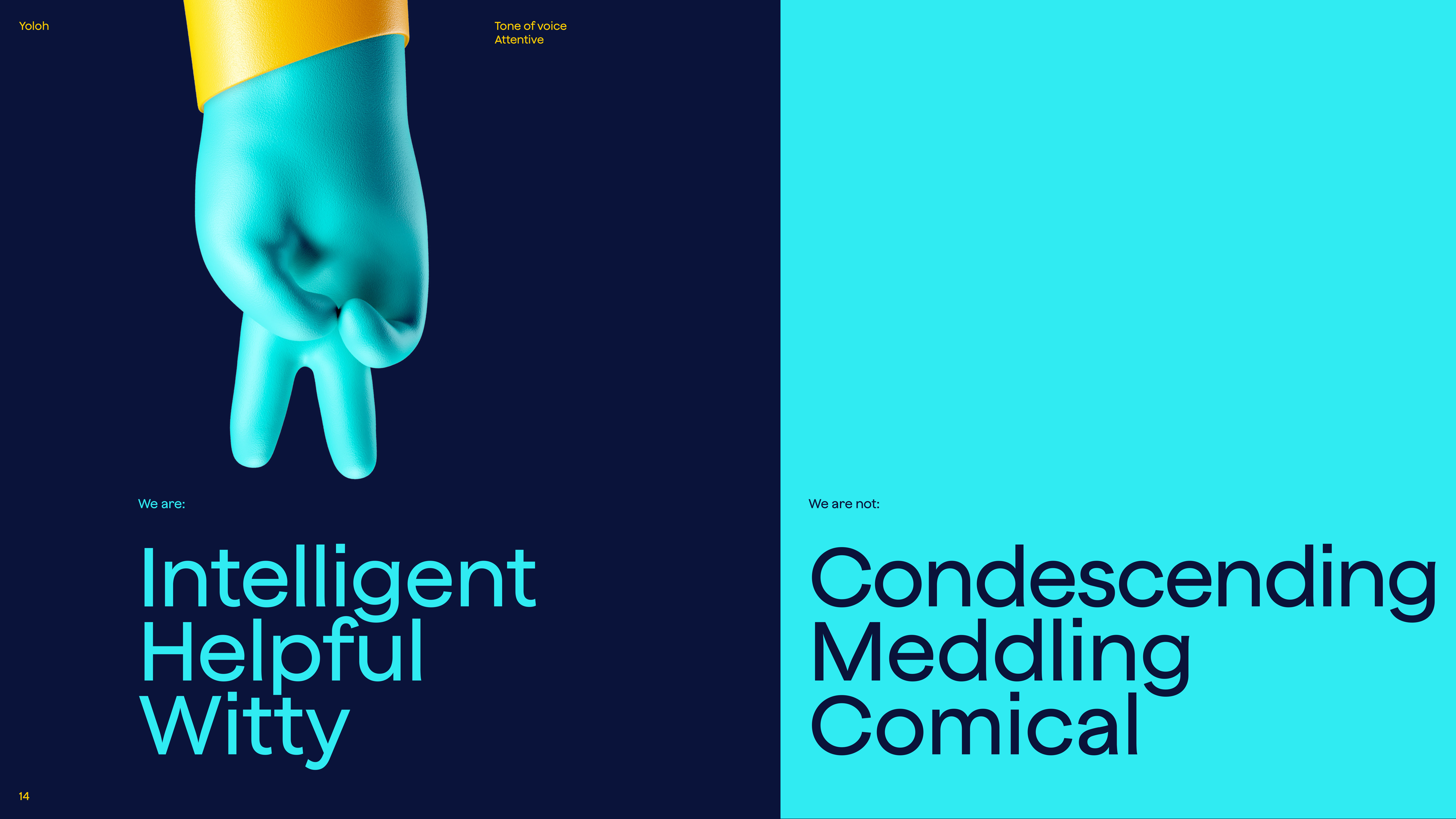
At the heart of the brand expression is four-fingered digital assistant ‘Andi’. When you first fire up the app, the phrase ‘Andi censured jumble’ is nimbly rearranged into the tagline ‘Insurance dejumbled’ โ€“ demonstrating the brand’s unique offer in a playful, memorable way.

Read more about the Yoloh strategy in Taxi’s case study.

Yoloh’s ambigram brand mark is identical when flipped upside down, inspiring the supporting line: “Making life easier, whichever way you look at it.”

Video credit: Taxi Studio

We then took the creative concept of ‘dejumbling’ to the next level, transforming the many different varieties of insurance into memorable, contextually relevant anagrams.

  • “Any incidents ruin me” became “indemnity insurance”
  • “Canal in dentures” became “dental insurance”
  • “Mourns a Citroรซn” became “motor insurance”

These weren’t just wordplay โ€“ they symbolised how even the most tangled concepts could be unscrambled into something human and approachable.

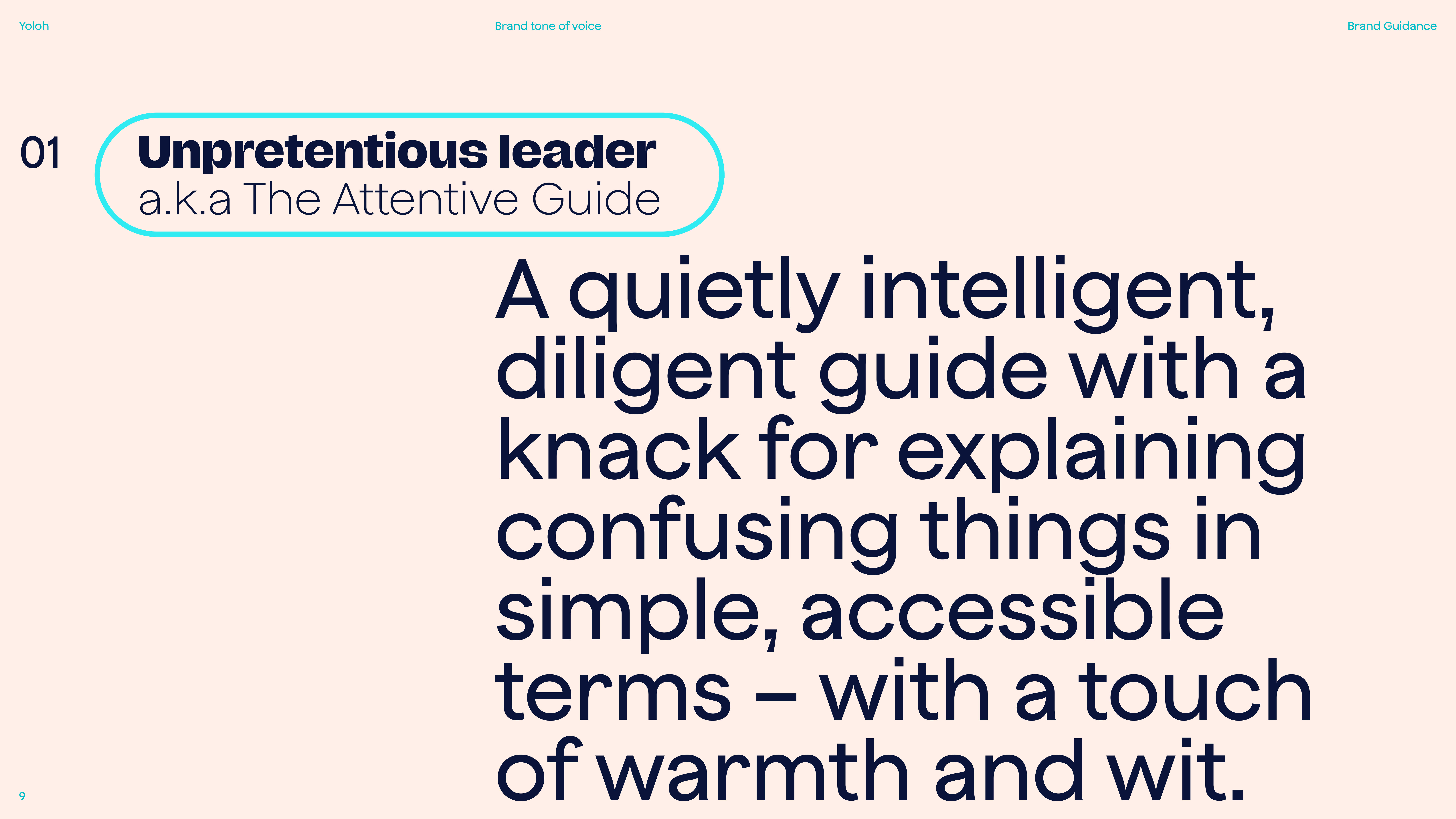
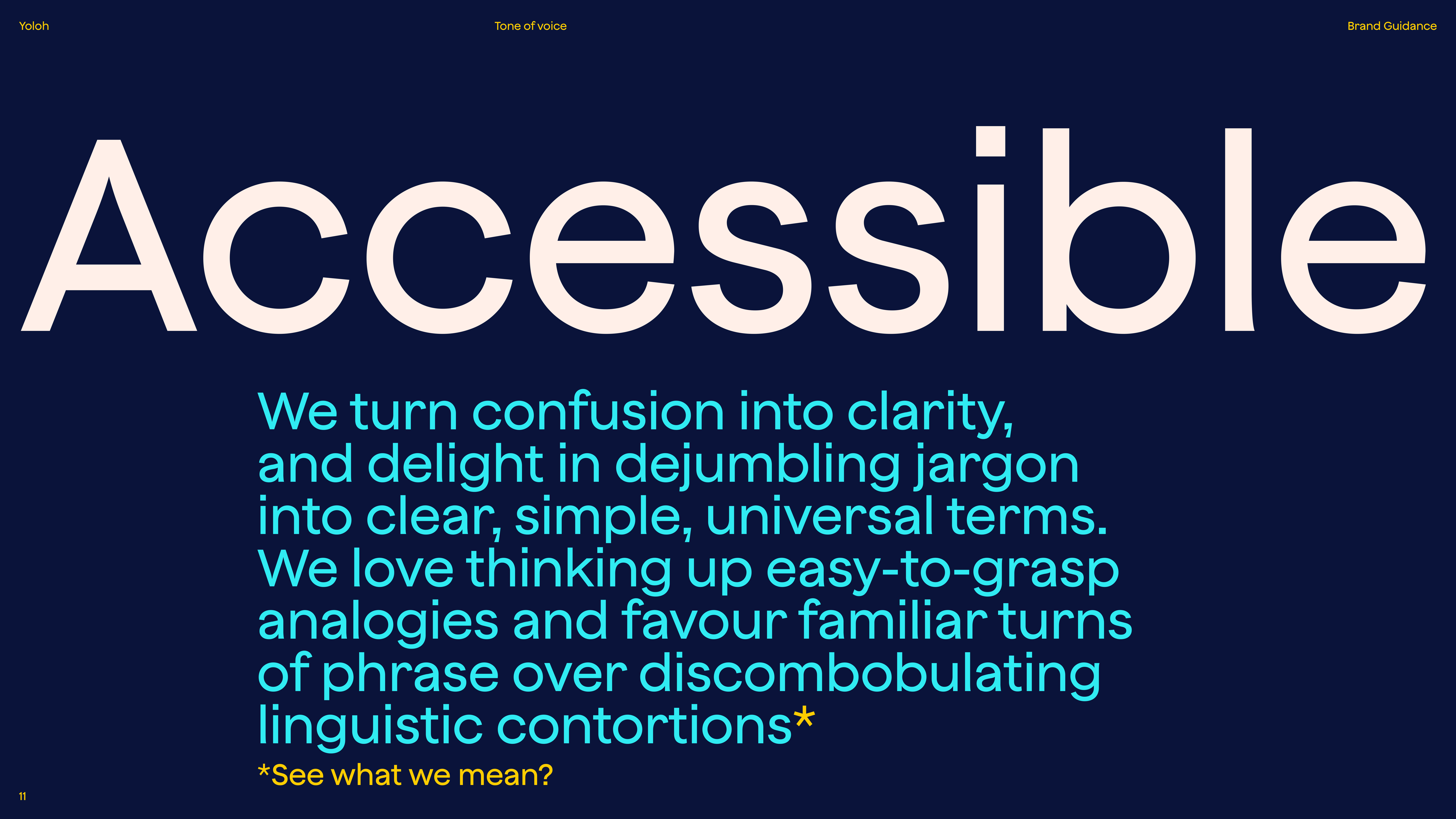
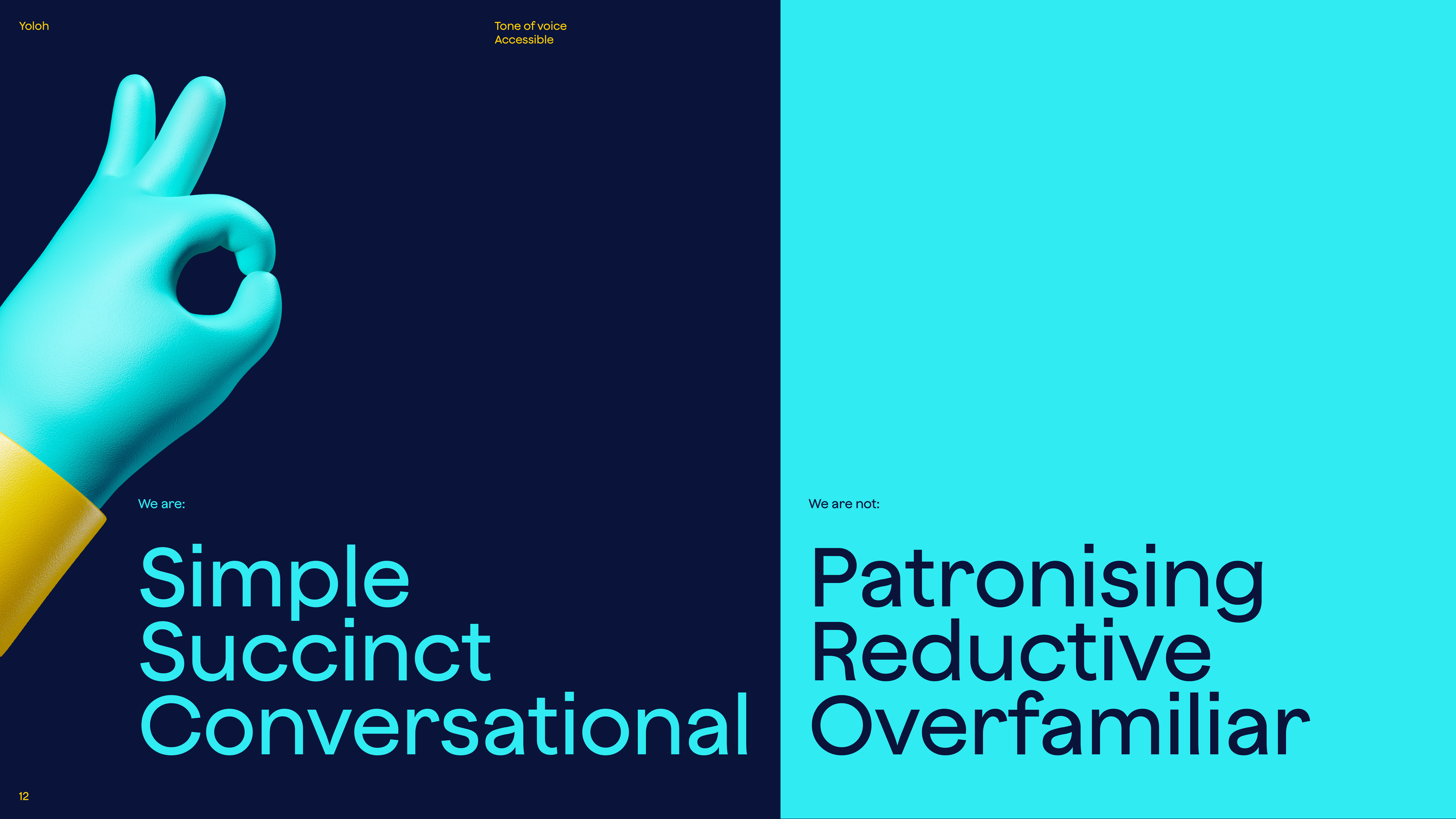
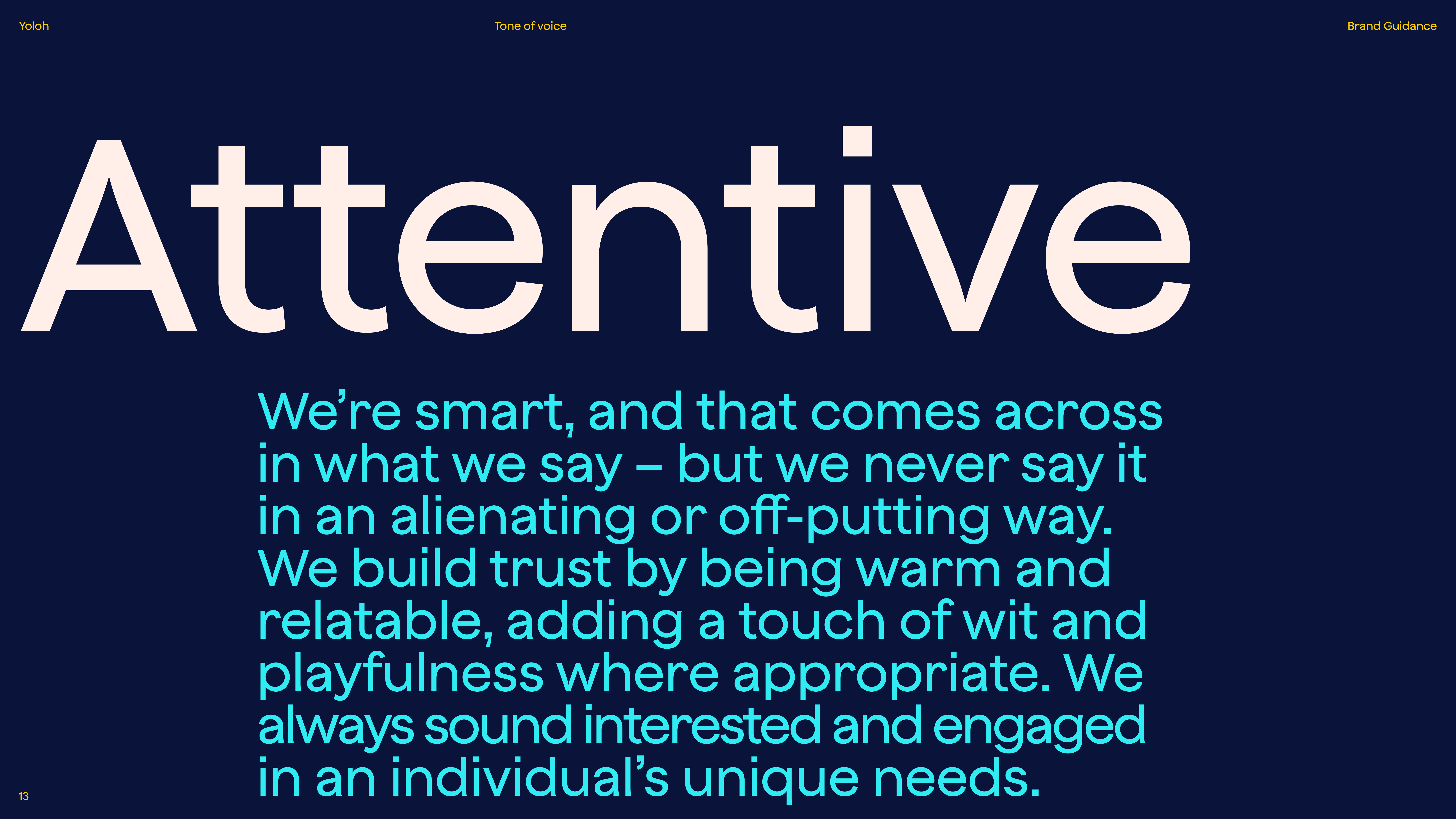
I developed Yoloh’s brand voice, starting with a top-level brand personality: ‘Attentive Guide’. Built around three core principles โ€“ Accessible, Attentive and Proactive โ€“ the voice turns tedious policy wording into friendly, human conversations, with a touch of warmth and wit.

“The breadth and depth of Nick’s knowledge is such a rich foundation for his copywriting. He gets under a new brand’s skin quickly and with all the smarts in all the right places. He provides so much more to creative outcomes than words.”

Emma Hopton โ€“ creative strategist, Taxi Studio

Press coverage

Taxi Studio balances trust and play in Yoloh rebrand
Design Week

Taxi reveals new brand for insurtech platform Yoloh
Creative Boom

How a fun rebrand and a new mascot boosted this brand’s reputation tenfold
Creative Bloq

Overplaying their hand
Brand New (subscription needed)

Awards for Yoloh
Bronze Award โ€“ Brand Impact Awards 2025

Championing a cleaning brand’s sustainable vision

I helped Superunion tell the brand story of eco-friendly cleaning company Delphis Eco.

Following a joint briefing with the creative team and the client, I conducted an in-depth interview with Delphis Eco’s passionate, self-confessedly belligerent founder Mark Jankovich.

The first section, below, captures the story’s unlikely origins in the world of cut-throat finance โ€“ where Jankovich had the epiphany that drove him to drop everything and radically change his career direction.

“I woke up one day and thought, ‘Enough’s enough.'” โ€“ Mark Jankovich

Mark’s story

It was 2007, the year before the finance sector went into meltdown.

Mark had been working on a more joined-up approach to RBS Groupโ€™s corporate social responsibility. He argued that the banking giant needed to consider its impact on the world.

But profit was king, and Markโ€™s holistic plan was laughed out of the room. He quit the next day, with a burning desire to make a meaningful difference in whatever way he could. His goal was simple: build a business, any business, that could have a net-positive impact. After scouring the globe for candidates, he discovered a Liverpool-based chemist making professional-standard cleaning products from eco-friendly natural ingredients.

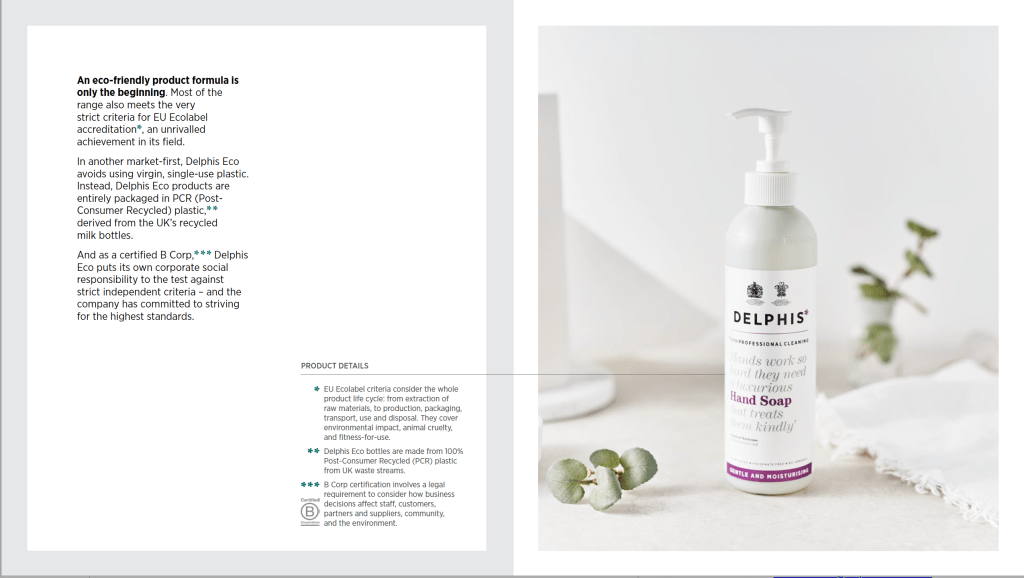
Delphis Eco leads by example when it comes to sustainability

The business had been struggling, and had racked up significant debts. But despite having no experience in the sector, Mark saw huge potential for social and environmental impact.

Shortly after the birth of his second child, and with no salary as a safety net, he threw everything he had into the venture, adopting a one-star roadside hotel as a rudimentary base near the warehouse in Bootle while he worked to turn the business around.

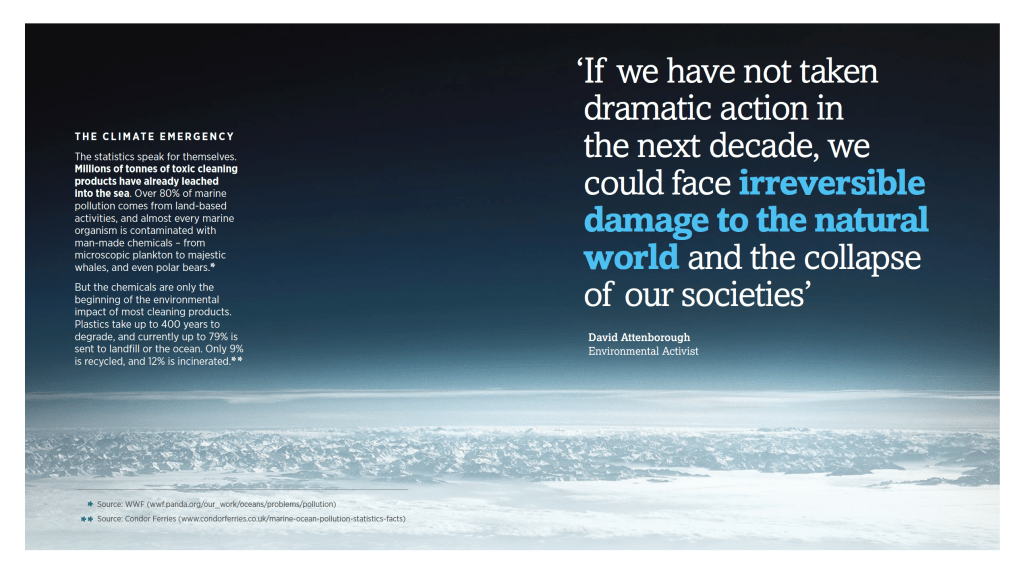
The brand story is set firmly in the context of the global climate emergency

Mark was prepared to roll up his sleeves and get his hands dirty. To win one of Delphis Ecoโ€™s first major contracts, he spent seven months getting up at 4am to scrub Iceland stores, demonstrating to the supermarket why it should switch.

He also knew he had to get the products into the right hands, so cut out the middleman. Knowing the Prince of Wales to be an ardent eco-campaigner, he cold-called Clarence House and challenged the Princeโ€™s staff to test the products. The risk paid off, ultimately leading to Delphis Eco receiving two Royal Warrants.

At the heart of Delphis Ecoโ€™s success story is Mark’s refusal to accept something is impossible, and the passion, belligerence and drive to prove it can be done.

Mark has lobbied the UK government to promote sector-wide change

The story goes on to explore how Delphis Eco has responded to the bigger-picture context of the climate emergency, and reveals the brand’s many sector-leading green innovations and related campaigns โ€“ including lobbying for meaningful change at the highest level.

Now’s the time to sharpen your agency’s focus

In this brutal climate, it pays to think more strategically.

The world’s in lockdown. Remote working is likely the norm for your clients as well as your agency. Video chats are a way of life, professionally and personally.

We’ve all had projects paused, postponed or cancelled. These are testing times. For anyone working with clients in the hardest-hit categories, such as travel and hospitality, it’s particularly brutal.

Protecting the health and job security of your team, and the long-term survival of your agency, are the order of the day. You need to hit the ground running once the dust settles.

Social distancing in the age of corona. Photo by Jake Bradley on Unsplash

To do that, it’s more important than ever to review what, and who, your agency is for. Short-term cashflow from current clients is key, but you must also keep communicating to prospective clients why design is an investment, not a non-essential cost. Of course, you must also convince them that your agency is best placed to add that value.

That’s where your content strategy comes in. When all the hatches are battened down, it might feel like you’re running to stay still. The priority list is long, and there are plenty of fires to fight. Clarity is what you need.

Read more: Why your design agency needs a content strategy

In recent months, I’ve been collaborating with three very different agencies to help clarify and communicate exactly what makes each of them special.

Two of them are industry veterans with already stellar client lists, looking for laser focus to explain the unique appeal of their purpose and process to the next great client.

The third is an exciting start-up with a compelling niche, keen to persuade brands of the value it can add.

With every brand imaginable filling inboxes with their take on the coronavirus outbreak, news feeds stoking anxiety and uncertainty, and the day-to-day filled with the practical challenges of handling the crisis, it’s hard to see the wood for the trees. But it’s essential to do so.


Need help getting focus amidst the chaos?

Celebrating 50 years of the Virgin brand

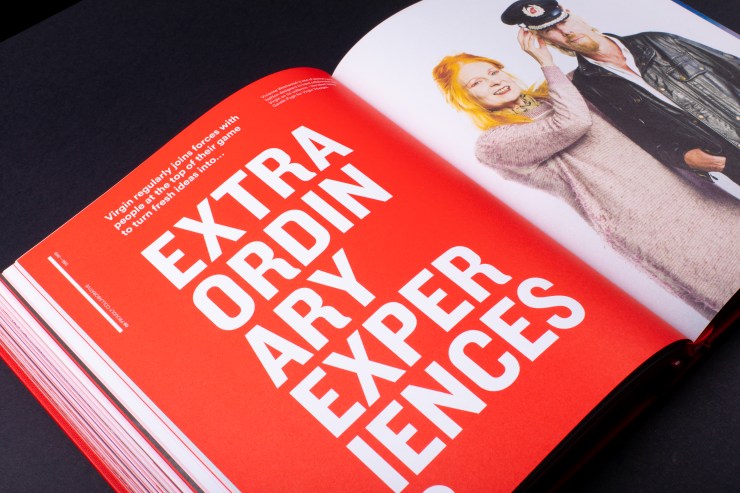
I am the author of Virgin By Design, a premium ‘coffee-table’ book celebrating 50 years of the Virgin brand.

Collaborating closely with the Virgin Group brand team and the book’s publisher Thames & Hudson, I helped develop a content strategy to appeal to brand designers, creative marketeers and ambitious entrepreneurs.

Rather than a chronological retrospective, we agreed it would be more compelling to tell the story thematically, exploring the unique characteristics that make the Virgin brand special.

Buy a copy of Virgin By Design on Amazon

The process involved over 120 interviews with CEOs, CMOs and other influential individuals responsible for shaping the past, present and future of the Virgin brand โ€“ from the early days of Virgin Records and Virgin Atlantic in the ’70s and ’80s, through to present-day innovations from the likes of Virgin Galactic and Virgin Voyages.

Drawing on hundreds of thousands of words of transcript, I crafted the many diverse stories into 10 distinct chapters. These explored areas such as Virgin’s ‘cheeky start-up’ mentality, the importance of taking risks and innovating, the ‘feel-good experiences’ and ‘magic moments’ at the heart of the brand, and how Virgin can stay relevant for the next 50 years.

With multiple senior stakeholders involved โ€“ including Virgin Group’s chief brand officer and global CEO, as well as Richard Branson himself โ€“ my copywriting brief was to capture Virgin’s brand values, while remaining engaging and entertaining for an external audience.

Nick helped us shape a cohesive narrative from multiple voices. He was quick to understand Virgin’s brand principles and history, and convey it seamlessly throughout the book. Nick’s skill in finding compelling stories translates to a joyful yet comprehensive read. He was a joy to work with.

Charlotte Bufton โ€“ brand manager and project lead, Virgin
Virgin By Design’s 10 thematic chapters. Image credit: Virgin

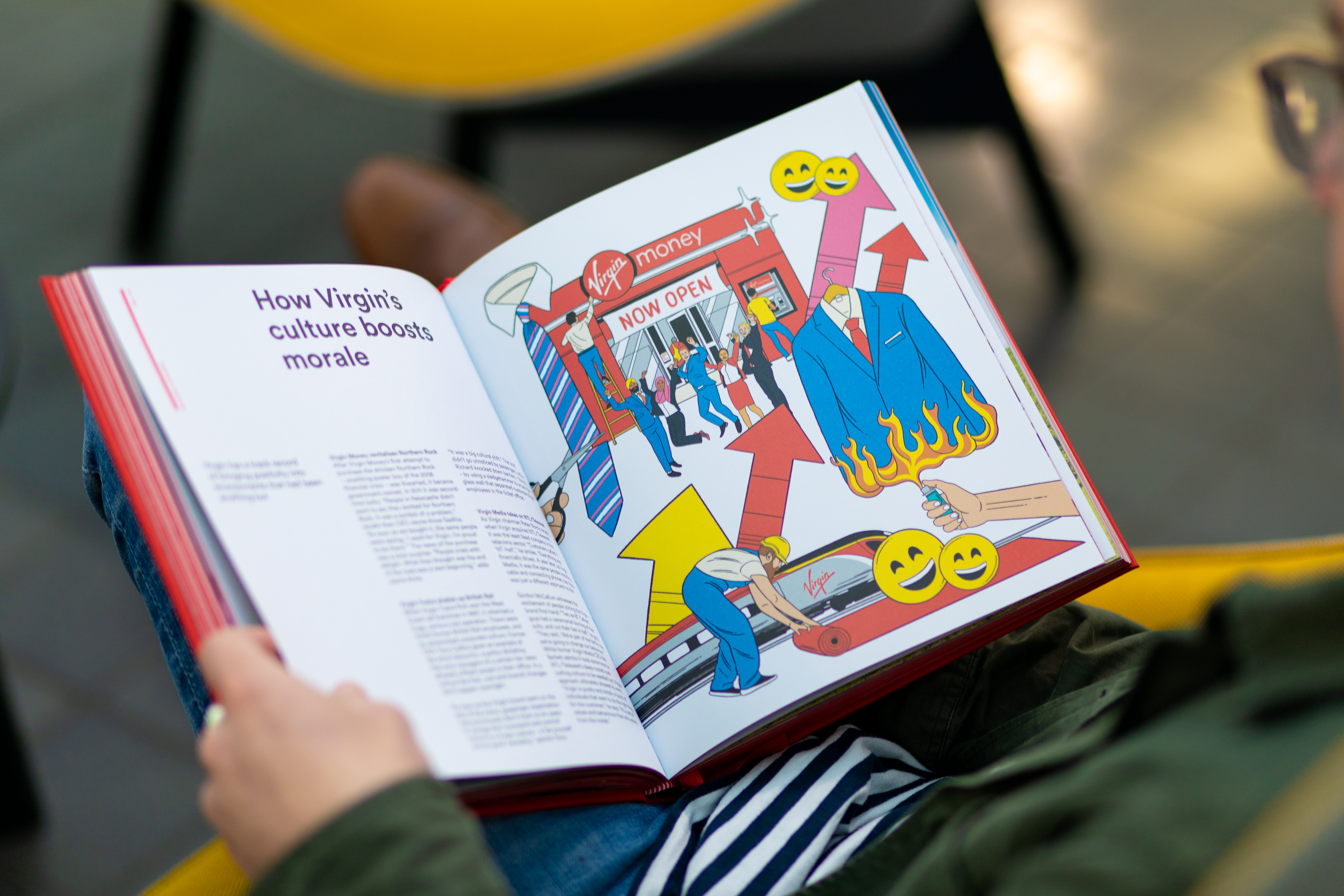
Fascinating archive photography, striking campaign visuals and playful commissioned illustration bring the featured stories to life.

The design, by Pete Rossi at RM&CO, encourages different levels of engagement. Readers can flick through for visual inspiration, or deep-dive into each chapterโ€™s theme.

Content formats vary from bite-size captions to long thematic reads, bound-in as inserts amongst full-bleed images to maximise visual impact. Gatefolds expand the canvas at key points to do milestone campaigns justice.

“Nickโ€™s deep understanding of how branding and design work within a business, and his industry knowledge and contacts, make him an invaluable member of a creative team.”

Andrew Sanigar โ€“ commissioning editor, Thames & Hudson

Virgin By Design was published by Thames & Hudson in March 2020.

Awards for Virgin By Design
Silver Award โ€“ Graphis Design Annual 2021
Highly Commended โ€“ Drum Design Awards 2020
People’s Choice โ€“ Creativepool Annual 2020

Why your agency shouldnโ€™t write everything in-house

Have you found the right balance between in-house and freelance copywriting skills?

In my experience, every design agency sees the relationship between words and design slightly differently. That includes the role copywriting plays in your process; at what stage it’s considered; and who actually writes it.

Perhaps you outsource all your copywriting needs. Or you might handle some of it, but bring in specialists for particular projects. Some agencies have fully fledged in-house departments to take care of it all.

Whatever your set-up, copy is most powerful and effective when it’s baked into the design process from the start โ€“ not bolted on as an afterthought. It should be a collaborative, two-way relationship.

That’s particularly true when working with an external consultant. If you’re not on the same page, you risk wasting time and money. But get it right, and both you and your clients will benefit from a totally fresh perspective.

So what does this look like in practice?

Two years ago, I left my full-time role as a design journalist and editor to become a freelance consultant. It wasn’t a snap decision: I’d spent the best part of a year considering how my editorial background could best complement different types of agency model.

Part of this was translating journalistic skills into compelling copywriting and brand storytelling. But while freelance copywriters are plentiful, it’s a lot rarer to find someone with an in-depth understanding of the design industry, and how the creative process works.

I’ve spent years interviewing designers to get to the heart of how they work, and find the most interesting way to tell the stories behind their projects. I’ve scanned more agency press releases than I care to remember, and reviewed thousands of entries to the Brand Impact Awards.

Presenting the Brand Impact Awards in 2018. Image credit: Future

All this has taught me that it’s not just your clients that need great copywriting. It should play a big role in your agency’s internal operations too โ€“ because that’s what sells your creative approach to the next client.

Read more: Why your design agency needs a content strategy

Why work with an external consultant to do this? As one client said to me recently, it’s all too easy to get ‘snow-blind’ when you’re too close to things.

I know what’s unique โ€“ and crucially, what isn’t โ€“ about what your agency does, and can help you develop a content strategy that tells that story in a convincing way. And if it works for you, it’ll work for your clients too.

Does your agency need a fresh perspective?

Why your design agency needs a ghostwriter

Full of strong opinions, but short on time to articulate them?

At its best, design is a thoughtful, considered profession as much driven by bold ideas as aesthetics. And as a cursory dip into ‘design Twitter’ will attest, there’s no shortage of opinions in this business.

But be honest. How often do those opinions become part of a joined-up, effective content strategy for your agency to win new clients?

Read more: Why your design agency needs a content strategy

Whether selling a bold solution to a wary client or crafting a brand strategy to win over sceptical consumers, designers are in the persuasion game. But current client demands come first. Getting thoughts down on paper in a coherent way takes time to do properly. And you need to do it properly.

It’s no use forcing out opinions for the sake of it. If it’s not your authentic standpoint, what’s the point? You need to find an engaging, relevant angle that sheds light on how you work, how you think, what makes you unique.

If all this sounds familiar, but you struggle to prioritise getting it done, I can help you articulate a client-winning thought-leadership strategy โ€“ including persuasive content that’s ghostwritten in your agency’s voice.

My editorial background helps me get to the heart of your story quickly, and craft a convincing narrative pitched at your target reader. And whether it’s a one-off piece on a particular theme, or a big-picture content strategy that runs for months, it begins with an in-depth, face-to-face chat.

This is a great opportunity not only to gauge what your opinions and attitudes are, but how you express them โ€“ from general style and mood to particular turns of phrase. Tone of voice is a crucial part of any branding toolkit for your clients, so why neglect your own?

Once we agree on an angle, tone and format, I’ll collaborate closely with you to get the content spot-on.

So what does this look like in practice?

I worked with the Red Setter team on a provocative thought-leadership article about โ€˜brand euthanasiaโ€™ for their client B&B Studio, to fuel its reputation for empowering disruptive, forward-thinking challenger brands.

Marmite: B&B’s example of a heritage brand that has stayed relevant. Image credit: City AM

In the firing line: lazy, slow-moving brands that have lost their relevance, but are kept on life-support by empty โ€˜brand refreshesโ€™ and nostalgia.

Fuelled by expert insights and contentious opinions from B&Bโ€™s senior team โ€“ including bylined strategy director Lisa Desforges โ€“ the short, punchy ghostwritten article was placed by Red Setter in City AM’s opinion section.

Case study: B&B Studio on brand euthanasia

I also helped Studio Output produce a long-form piece to reflect its new strategic positioning: the agency helps brands to adapt and thrive in a connected world.

Following an in-depth briefing session with the senior team, I worked closely with ECD Rob Coke to express the agencyโ€™s sector-leading creative approach in written form โ€“ using three case studies to show it in action.

Case study: Studio Output’s strategic repositioning

Looking forward to 2020, I’m collaborating with three very different UK agencies on their longer-term strategic content plans, which will start rolling out in the coming months. More on that in due course.

Need help turning your in-house expertise into client-winning thought leadership?

Why your design agency should invest in video

Is your approach to video content working?

In my six years chairing the Brand Impact Awards judging panel, I’ve seen a growing trend for polished videos supporting entries. The best examples function as mini documentaries, telling the story of a project from the perspective of the client as well as the agency.

Clearly this route is more accessible to larger, better-resourced agencies. Bespoke video content doesn’t come cheap, certainly compared to submitting some static images with a written supporting statement. Small, boutique studios may struggle to compete on a level playing field.

But if you only see video as a cost, you’re looking at it wrong. With the right approach, it can form a key part of your design agency’s content strategy.

Read more: Why your design agency needs a content strategy

Told in the right way, the story of a ‘portfolio centrepiece’ project will draw people in and add depth and colour to your creative process. Putting your people on camera also gives your agency an engaging, human face that makes it more accessible and relatable to prospective clients.

If it’s worth doing, it’s worth doing right. That means you need to pick your battles, as costs can add up quickly. Some projects have a rich, visual story that video can bring to life effectively โ€“ others don’t.

You don’t need a Hollywood film crew to shoot an Oscar-winning masterpiece. But telling that story in a compelling way takes more than a camera operator, a sound recordist and someone to edit it together. You need an editorial eye.

So what does this look like in practice?

As discussed in my last post, video was a crucial part of my content strategy for Taxi Studio’s global Carlsberg rebrand.

There were several strands to be explored editorially, and the particularly close collaboration between agency and client on the project merited input from both sides of the table to tell the full story.

Filming Taxi Studio’s Spencer Buck and Carlsberg’s Jessica Felby in Copenhagen [Watch here]

Accordingly, as well as conducting in-depth on-camera interviews with the creative team in Taxi’s Bristol-based studio, we filmed several members of Carlsberg’s brand team in their Copenhagen HQ.

With three agency-side and six client-side interviews to work with, careful scripting was required to cut between multiple perspectives within a few short minutes. Liaising closely with Taxi’s in-house editor, I structured a smooth, engaging narrative for each video.

Case study: Video series exploring Taxi’s Carlsberg rebrand

For the launch of The Clearing’s new book Wild Thinking, I worked closely with the agency’s marketing team, and publisher Kogan Page, to put video at the heart of the content strategy.

The premise of Wild Thinking is about asking challenging, provocative questions to get to the heart of a brand. That lent itself perfectly to an interview format, digging deeper into the themes inside the book.

McLaren CMO John Allert discusses how mediocrity is a motivator [Watch here]

I conducted on-camera interviews with three of the featured brands: McLaren, Dropbox and Royal Ascot. With almost an hour of footage from each interview, I then scripted punchy three-minute videos โ€“ as well as shorter cuts for use on LinkedIn and Twitter.

Case study: Video interviews to promote Wild Thinking

There’s an art to steering an on-camera interview, particularly if people aren’t used to being in front of the lens. If the conversation feels natural, an interviewee feels more comfortable and their answers flow.

This often requires changing the line of questioning on the fly to ensure the most interesting content is captured, and in a usable format. For short-form video, you need engaging soundbites that can be edited together easily.

It’s a skill I’ve honed over many years. At Channel 4, I produced regular short-form video documentaries showcasing emerging creative talent.

During my tenure as editor of Computer Arts, I produced a long-running series of video profiles at top agencies across the UK. These included Pentagram, JKR, The Partners, DixonBaxi, SomeOne and many more.

CA studio documentary filmed at JKR. Image credit: Future

Rather than just focusing on media-trained founders and creative directors, these videos were designed to present a cross-section of agency life. We interviewed people from different tiers and departments, all of whom had plenty of interesting things to say, but were rarely in the spotlight.

Watch now on YouTube: CA studio documentaries

For many clients, my varied experience in the editorial and broadcast sectors, combined with in-depth knowledge of agencies’ creative and strategic processes, makes an ideal sweet-spot when it comes to video.

Does your agency need to rethink its video strategy?

Why your design agency needs a content strategy

Is your portfolio working hard enough to win you new work?

I’ve heard the same problem from agencies of all sizes. Time is tight, the team is stretched, and hours spent updating the website aren’t billable.

Once a project is wrapped, it’s onto the next one. Writing the case study is all-too-often a necessary evil to keep the website fresh, perhaps feed into awards submissions further down the line, hopefully get some design press attention.

Stop. Look at it differently. Invest a little more in telling the story in the right way, and your completed projects don’t just show off what you did for one client โ€“ they show off how you can work with any client. They sell your creative process, not just your creative output.

Case studies can tell a powerful story about what makes you unique, and why clients should hire you. But to get it right, you need a content strategy.

People fetishise ‘thought leadership’. And if you have something genuinely thought-provoking to say, or an inflammatory opinion on the latest hot topic, it can be a great platform.

Read more: Why your design agency needs a ghostwriter

But to achieve real impact, you need to apply the same kind of strategic rigour to how you talk about your work. Use your case studies to add colour to a wider narrative about how you think, collaborate and solve problems โ€“ not just why you chose a particular typeface or colour palette.

So what does this look like in practice?

When Studio Output set out to redefine its strategic positioning โ€“ the agency “helps brands to adapt and thrive in a connected world” โ€“ I worked with the senior team to help craft a centrepiece article, setting out the stall.

At the heart of the piece was one core message: the experience of your digital products is what defines your brand. In order to thrive, established brands must adapt, embracing the potential of brand-led user experiences.

Image credit: Studio Output

Case study: Studio Output’s strategic repositioning

Crucially, the piece didn’t just discuss this topic in the abstract. Case studies for BBC Sport, Auto Trader and Pottermore were an integral part of that narrative, adding colour and substance to the argument, and making a compelling case to clients facing similar problems in different sectors that Studio Output’s approach could be the answer.

Sometimes a single project has enough value as a portfolio centrepiece to benefit from its own content strategy. Before the launch of Taxi Studio’s global Carlsberg rebrand, for instance, I collaborated with the agency to help identify the most interesting angles on the story.

My strategy was to split the project into three strands: re-crafting the core brand assets; developing a holistic packaging system; and exploring Carlsberg’s wider sustainability story, in which the rebrand played a key role.

Image credit: Taxi Studio

Case study: Taxi Studio’s Carlsberg rebrand

After conducting a series of on-camera interviews with key figures involved with the rebrand from both agency-side and client-side, I scripted three short video documentaries โ€“ and worked with Taxi’s in-house editor to help tell the story in a succinct, engaging way. I also wrote accompanying long-form articles to dig deeper into each facet of the story.

The strategy worked, piquing the interest of different corners of the design press: Computer Arts went behind-the-scenes on the reworked brand assets; The Dieline ran an exclusive deep-dive on the packaging system; and Creative Review explored the sustainability story in more detail. The videos were also used in many successful awards submissions.

Read more: Why your design agency should invest in video

These two examples represent opposite ends of the same scale: one uses multiple case studies to add substance to a larger narrative, the other expands one case study to tell a multi-tiered narrative. But both offer value far beyond showcasing completed projects, and show prospective clients how these two top agencies solve creative problems in style.

Is it time your agency had a content strategy?